

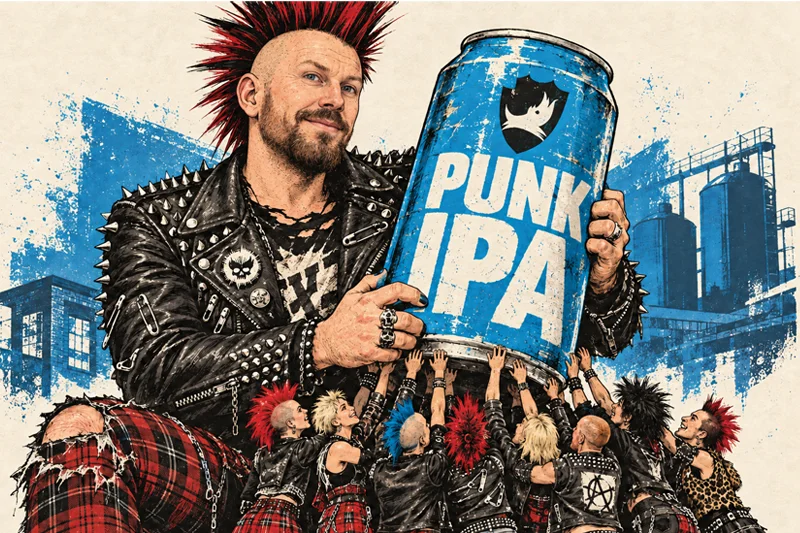
Remember BrewDog? That scappy Scottish craft beer brand that started in the small town of Fraserburgh, Scotland, in 2007? This week, under the ownership of publicly-traded Tilray Brands, BrewDog launched its ‘Choose Craft’ campaign in the UK. To fully appreciate this move, you may need a quick refresher on BrewDog’s history.
Born in 1982, at least a decade after the UK’s punk craze. Spent his early 20s as a licensed deep-sea fishing captain. Educated in law and economics—his BrewDog co-founder Martin Dickie was the trained distiller.
2016 was a big year for Watt. He open-sourced BrewDog’s recipes to the general public, earning him ‘post-capitalist’ cred, though he cashed out a year later (see note 2). He published a book, ‘Break All the Rules—The BrewDog Way’. Rounded the year out by being appointed to The Most Excellent Order of the British Empire (MBE), a few rungs below knighthood.
Started a reality TV series (of course). At age 40, he disclosed an autism and ADHD diagnosis.
Tried unsuccessfully to buy BrewDog back from Tilray in July of this year, which embroiled him in a data privacy controversy.
The short and the interesting
BrewDog has a short, interesting history. Short because it has only been around for 19 years. Interesting for three reasons:
- It eschewed paid advertising (like all craft brewers) for publicity stunts, unpaid media coverage based on stirring up controversy based on the names of their beers and the general antics of co-founder James Watt.
- At least partly because of #1 above, it was a hugely successful business, growing to be one of the biggest craft brands in the UK and around the world in a 10-to-15-year timeframe.
- From 2009 to 2021, crowd-funding raised at least £75m (US$ 100m) to support brand growth. It was the first craft beer brand to raise this level of relatively unencumbered financial support. Crowd-funding also created 200,000 brand advocates.
Of course, BrewDog moved to paid advertising exactly when it needed to, but it was constantly battling with UK beer industry regulator The Portman Group. For innocent things like promoting ‘anti-social behaviour and rapid drinking’, mocking homeless people, trans women and sex workers, using misleading health claims, falsifying the value of ‘solid gold’ promotional beer cans, etc. In the few instances where BrewDog chose to address complaints, it was usually in the form of mocking the WatchDog and/or the offended target group.
This bad (marketing) behaviour was not just for the cameras. BrewDog employees formally and publicly complained about a toxic ‘culture of fear’ at the company [1]. Those complaints usually involved Watt—the tone and character of an organisation always flows down from the top.
To be fair, after Watt was somewhere between decamillionaire and centimillionaire (in US$) [2], he shared some of BrewDog’s good fortune with his original crowd-funders and then-current employees through share transfer and profit-sharing schemes. Both were put in place but were reduced as BrewDog’s financial situation deteriorated. People like Elon Musk and Steve Jobs don’t do this kind of thing. If you want a bit more on Watt, see sidebar right.
When counter-culture becomes culture
BrewDog began generating substantial sustained losses in 2020. This can certainly be partially attributed to COVID and the general maturation/decline of the craft beer segment. But we think it can mostly be attributed to the brand’s counter-culture/punk positioning no longer being unique nor relevant to its customer base. If counter-culture personality is your brand, and you evolve to become the culture, your positioning stops working for your brand. And the person behind it.
BrewDog was never a true craft beer brand because it was never about the liquid. Sure, it won a couple of World Beer Cup Gold medals in its first few years of being a true craft brewer, but not after that.
If BrewDog is ‘global craft’, Guinness is much bigger and better global craft.”
Back to faux craft, again
To its credit, BrewDog does everything in a big way. To us, this month’s ‘Choose Craft’ campaign is an attempt to return to true craft beer benefits and positioning when BrewDog is no longer a craft beer brand other than by its owner’s generous definition. If BrewDog is ‘global craft’, Guinness is much bigger and better global craft.
Yes, BrewDog is faux craft, as we’ve been talking about in Marketing Wilderness lately. And that’s fine, as long as you don’t pretend it isn’t.
It’s hard to imagine Tilray’s bet that BrewDog can get its mojo back in a mature market with a brand positioning based on generic category benefits. Benefits the brand didn’t rely on in its amazing first life. Management committees love sequels. We will see if consumers buy in.
- Megan Bonar, “Brewdog boss James Watt steps down from CEO role”, BBC Scotland News, May 8, 2024..
- In 2017, Watt sold a portion of his shares to private equity firm TSG Consumer Partners for $US 65 million.




Leave A Comment