Three marketing presentations on advertising effectiveness from 2025 caught our collective eyes over the past few months, for what they have in common and how they differ.
- “The Long and the Short (form) of it”– Andrew Tindall & Josh Fruttiger of System1 with Esteban Ribero of TikTok, June, 2025.
- “The Eye-Watering Cost of Dull Media” – Peter Field & Dr Karen Nelson-Field, October, 2025.
- “The Creative Dividend: Advertising That Pays Back” – Andrew Tindall of System1 & Effie Worldwide, January, 2026.
All three have similarities:
- All are about creativity’s crucial role in advertising effectiveness and are based on valid quantitative research.
- All have a beginning in, or pay homage to, Peter Field and Les Binet’s ground-breaking 2013 advertising effectiveness work, “The Long and the Short of It” (TLATSOI). This is the seminal research that gave birth to the 60:40 rule of brand-building campaign investment vs performance campaign investment.
- All involve the dataset(s) of System1 Group PLC, the UK-based marketing research and advertising effectiveness company.
Here’s a brief summary of each presentation, in order of publish date.
The Long and the Short (form) of It
This is ostensibly the application of TLATSOI thinking to two realities of current marketing communications:
- As long as social media exists (let’s go with forever), short-form video ads will remain the dominant ad format.
- Influencers/Creators have become an effective media subtype within social media, when used correctly [1].
The database here is TikTok users and their responses to System1-tested short-form creative, so this paper is best read as a platform-effectiveness study, not a business-effectiveness study. It shows that certain short-form creative features are associated with TikTok brand-lift and conversion-lift outcomes. Brand lift is a proxy for purchase intent. ‘Conversion lift’ comes from TikTok’s conversion lift studies and can be anything the advertiser defines it as: purchases, clicks, leads, app installs, add-to-cart events, site behaviours, or attitudinal proxies. That puts it a step below the other two IPA/Effie-based studies here.
The key learning for short-format video advertising is:
- Entertainment builds the brand, showmanship makes the sale and both need to show up very quickly. Here, Showmanship, as distinct from Salesmanship, appears to flow most recently from work by System1’s Chief Creative Officer, Orlando Wood.
- Brand size matters here, so category leaders have an unfair advantage using short-form video, meaning challenger brands need to push the entertainment/salesmanship envelope
The key lesson? The basic tenet of TLATSOI applies to short-form video advertising, which is that emotion is critical. But the creative needs to create multiple Brand Effects almost instantly to get noticed and remembered the right way.
The Eyewatering Cost of Dull Media
Peter Field, co-author of The Long and the Short of It (TLATSOI), describes this presentation as the latest iteration of ‘The Cost of Dull Project’, which initially focused on dull creative defined as, ‘not good at attracting attention to your brand’. Here, his attention switched to dull media as a bigger problem because:
- Far more marketing budget is spent on media than creative.
- (Increasing use of) dull media leads to the increasing use of dull creative.
Field categorizes all or most short-duration/small-ad-format digital media, the kind most often used in performance marketing campaigns, as dull. This means display ads, skippable and short non-skippable video on the Google, Meta, Amazon, ByteDance (TikTok) and Microsoft platforms.
The crux of Field’s cost argument is the huge 75% gap between ads that are served up and paid for as viewable on digital media platforms and ads that are actually seen by human eyes long enough to draw attention and create memory. This is based on a widely-acknowledged ‘attention-memory threshold’ of 2.5 seconds, below which your ad is not getting enough attention to be remembered.
So while media CPM analysis favours digital media, ‘attentive CPM’ does not. Curiously, today’s CPM-based media planning pushing brands head-long into digital and social media is, in fact, old-school thinking. Hence the problem and its growth.
The key lesson from this legitimate child of TLATSOI? Don’t be fooled by low CPM media platform numbers, which favour short-duration/small-ad-format digital and social media. You will end up be breaking the 60:40 rule to the detriment of your brand.
The Creative Dividend: Advertising That Pays Back
This is a long and dense 122-page presentation of research whose major accomplishment is the identification and measurement of key elements of advertising creative, how these link to Brand Effects and relate to Business Effects (moving forward, let’s call the latter Business Results). While Binet & Field’s TLATSOI did this in 2013, System1 does it at a more granular level. System1 also includes US effectiveness data (via Effie Worldwide) and much more media use beyond linear TV [2].
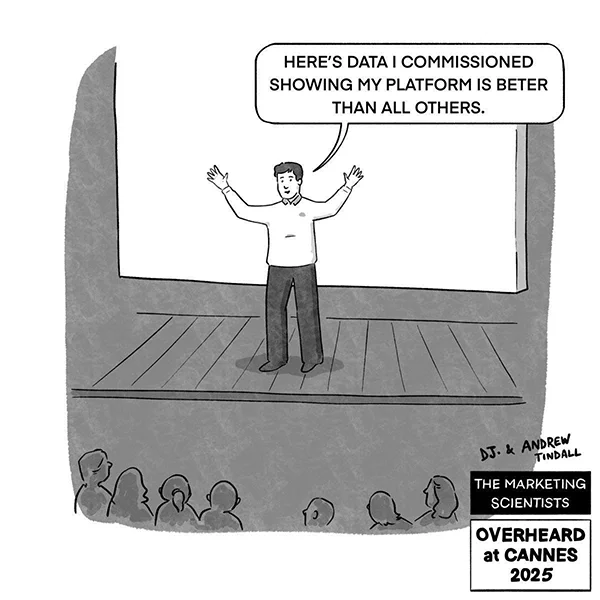 System1’s creative testing platform is at the front-end of this research. Test My Ad is System1’s core service to brands, so the cynical may suggest the research is primarily an advertisement for Sysem1. The less cynical will proceed with an awareness of the potential for bias. It’s unclear if author Andrew Tindall sees the irony in the cartoon (right) he co-created while working on this presentation.
The Creative Dividend is defined as a quantification (by System1’s Test Your Ad service) of how creatively advantaged a brand’s advertising is compared to its competitors. Think of it as the creative version of the media concept of ESOV (Excess Share of Voice). Since creative needs media to reach consumers effectively and efficiently to create Brand Effects and Business Results, System1 created this original formula:
ESOC = Creative Dividend x Media Spend (where ESOC is Excess Share of Creative)
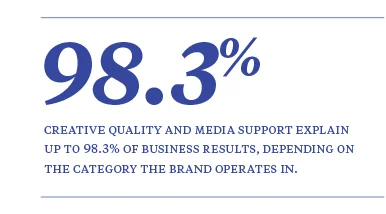
All good until this bold claim:
Even Byron Sharp, the Dark Lord of Effectiveness, came down from his tower at the Ehrenberg-Bass Institute to comment on this:
“The ‘creative dividend’? More like creative accounting…” [3]
When all measured category results are weighted and normalized, the R 2 is 60.1%. The Dark Lord is being a bit harsh. We believe what’s really happening here is co-causality. A company capable of producing award-winning creative that actually gets Business Results is getting most (or all) of the marketing mix right—not just the advertising.
The list of important Brand Effects discussed by Tindall seems to be getting bigger, or maybe just more granular. It includes:
The great Distinctiveness vs Differentiation debate
This presentation advises that brand distinctiveness is now more important than differentiation for brands success, a concept popularized as far back as the early 2000s by Byron Sharp and others with the Ehrenberg-Bass Institute. This is a claim I’ve always struggled with. What’s interesting here is that the debate is framed around Business Results including profitability, not just Brand Eeffects, the latter being where Ehrenberg-Bass started. Tindall states,
Differentiation supports all Business Results, but distinctiveness usually has an outsized effect.”
Later in the document, you will learn that differentiation is more important for challenger brands. This makes sense—a new brand needs to stand for something that’s relevantly different than the category leader(s)—which is the (old-school) concept of brand positioning. The category leader already has an established differentiation/positioning, therefore quick brand recall becomes more important for it. So we’re back to a ‘bothism’ answer on this debate.
The rise of Fame and Trust as important Brand Effects
Fame in this context certainly feels like an artifact of social media and/or our general cultural obsession with celebrity. The link between Fame (celebrity) and Trust feels like an artifact of North America’s current political attitudes.
The separation of Salesmanship and Showmanship
Historically, a good salesperson embodied the positive elements of showmanship. In 2015, Paul Feldwick popularised the delineation of Showmanship as a right-brained concept and Showmanship as left-brained. But when salesmanship moved from human-to-human to social media in short-format ads, the influence of the circus barker returned.
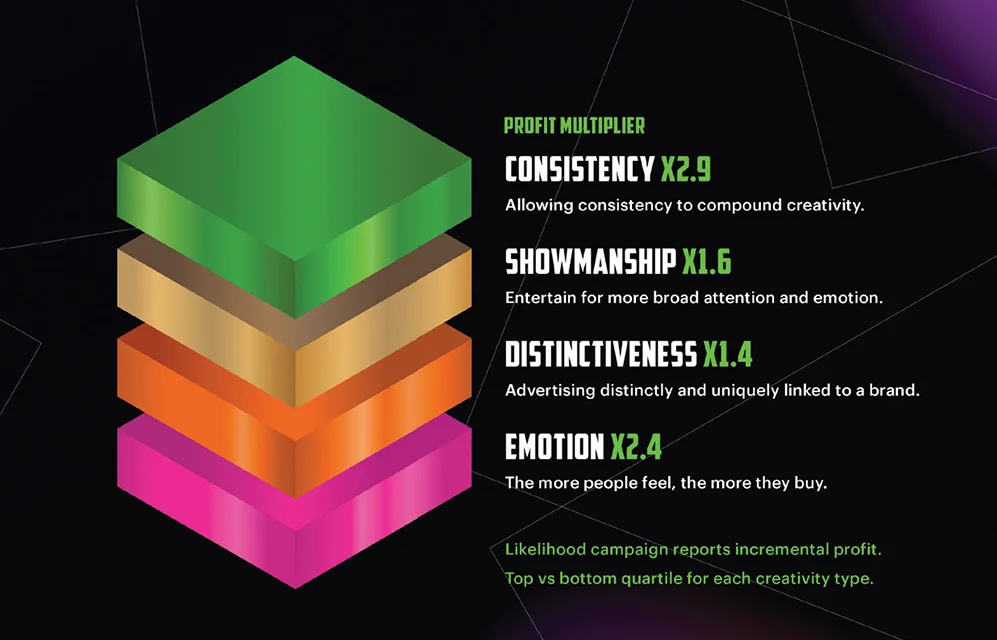
The Creativity Stack, page 28, The Creative Dividend
The most interesting thing Tindall presents is a tool called The Creativity Stack. It combines the top four Brand Effects currently affecting profitability and makes this claim based on System1 research:
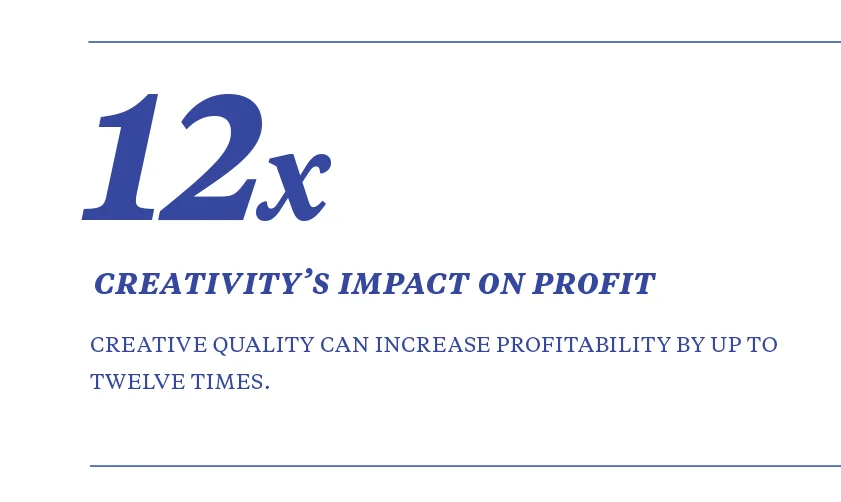
Impressive, even as an ‘up-to’ claim. There is good discussion on each layer of the stack. And for challenger brands? They deserve their own Creativity Stack that looks more like one from before social media.
There’s a chapter dedicated to media’s leading role in effectiveness which deserves its own post. And the conclusion is a practical planning guide, including creative research. Of course but rightly so.
The Short on Business Results
These three presentations provide good insight on how advertise effectively for Business Results, particularly the most recent two. But as proven by System1’s linear regression model, advertising only gets you half of the way there. Other more primal elements of the marketing mix need to contribute the rest. As Tindall states,
…price stands out as the most underutilized lever in modern marketing…(but is least-often reported as a business result).”
This is interesting, in that supporting price and/or pricing elasticity was probably the original purpose of the marketing discipline. It’s the least reported business result because it takes more time to appear than other results. It’s the best argument not to price discount to make your performance marketing campaign work better.
The most surprising thing revealed
Despite many decades of improving research, ad effectiveness is (on average) getting worse. This is true of all four Business Effect layers in The Creativity Stack. We’re not believing—or acting on—real effectiveness research, old or new. Andrew Tindall suggests the reason why in the curious ‘The Structural Challenges Facing Modern Marketing’ section of his introduction to The Creatiev Dividend.
 The thing hinted at but left unexplored
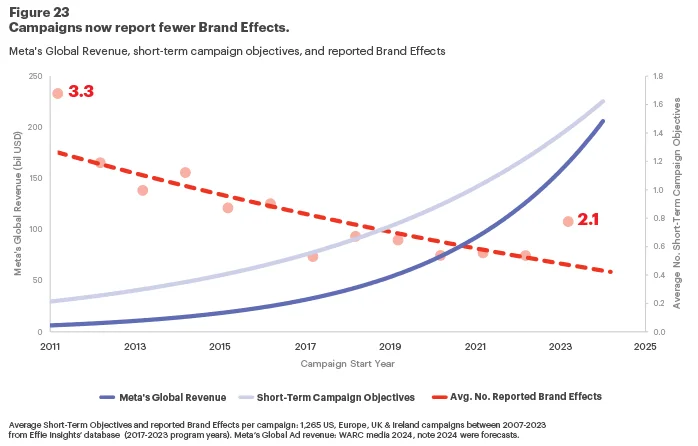
All three presentations hint at what is behind the decline in ad effectiveness, but don’t explicitly state it. Peter Field is the most direct—it’s actually the thesis of his presentation.
Tindall only goes as far as showing you a graph (right). Notice the direction of the dark blue line compared to the rise in short-term campaign objectives and the fall in average number of reported Brand Effects. Now check the legend to see what the dark blue line represents. And remember, this is based on effectiveness award-winning advertising.
It’s the social media giants pushing their platforms that’s causing the decline in advertising effectiveness. And the fact that most of us are buying their pitch. Let’s use social media effectively for business results, shall we?
- This is Coyote’s qualifier, not System1’s. An explanation requires a different post.
- IPA and Effie case studies now include far more digital, social, CRM, experiential and performance activity than the early IPA databank used for TLATSOI. But they don’t include those activities in proportion to real-world media spending or ad consumption. They remain databases of award-worthy effectiveness cases, not neutral or representative samples of all advertising practice.
- Byron Sharp, “The ‘creative dividend’? More like creative accounting”, marketingweek.com, March 25, 2026.
- Feature image credit: Norman Rockwell’ s Circus Barker, copyright: public domain US.