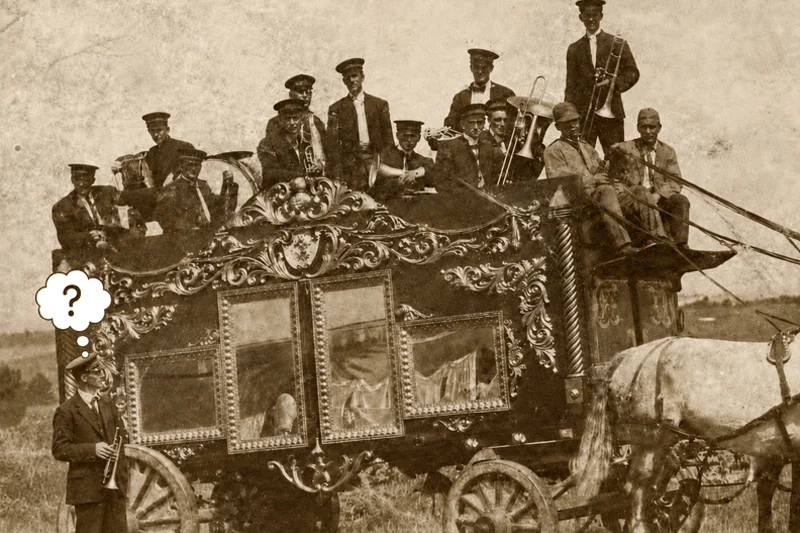
Before writing this post, I was of the mistaken opinion that Creator was a flattering rebranding of Influencer. Chalk that misunderstanding up to me not being an avid consumer of social media. Even though I have a new-found understanding of the Creator Economy, I will still suggest Influencers and Creators are doing very similar things, just at different places on the same spectrum. I see Influencers as celebrity (in the social media context) Creators. Apparently it’s the social media celebrity part that results in audience trust, which can be tranfered into trust for a promoted brand.
Trouble with Creators
Clearly, I’m having trouble with everyone’s favourite new digital media, just like I did 17 years ago with Twitter, back when it was still named Twitter and had a 140-character limit (see MW post ALL ATWITTER ABOUT NEW MEDIA [1] ).
The trouble I’m having now has mostly to do with consumers of Influencer content. The same people who might be consumers of your product or service. Do they really think a paid-to-pitch Influencer is more trustworthy than any other paid or earned media?
This time around, there is research to help me decide if I should be aboard the Creator bandwagon. System1, led by the unbiquitous Andrew Tindall, noted the rising importance of Creators in the recent report ‘The Long and the Short (form) of It.’, reviewed in an earlier MW post here: THE LONG & SHORT OF BUSINESS RESULTS.
More recently, System1 has created ‘The Creator Effectiveness Playbook.’ Let’s dig in.
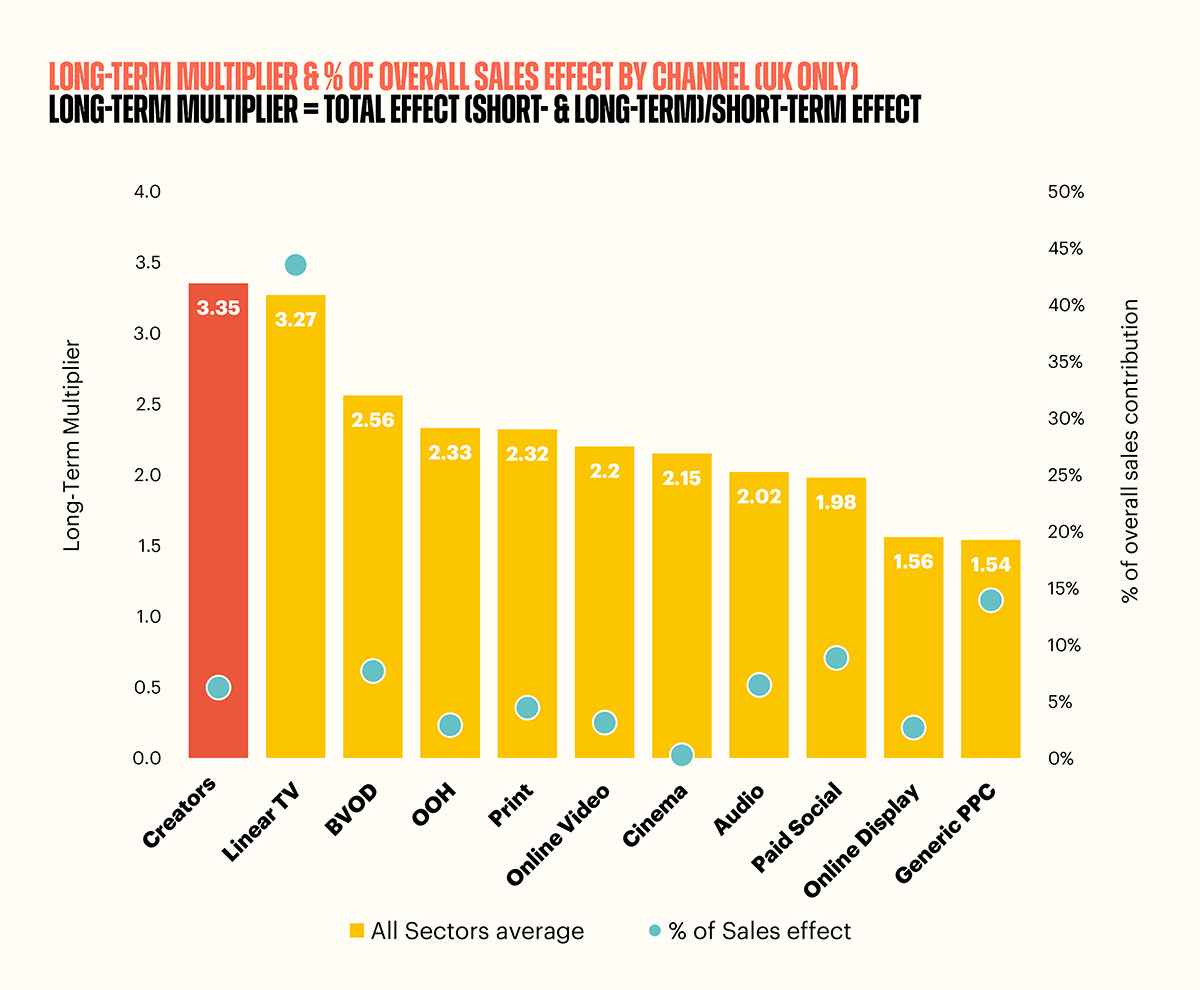
Here’s the first chart we come across:
Wow! At first glance, it looks like Creators are a better long-term brand builder or brand effects multiplier or business effects multiplier than all other media, including Linear TV. It’s not immediately clear what Creators are best at, because it’s not clear what’s being multiplied here. But at least they are best at something important.
The chart is actually saying that Creators have a total effect that is 3.35 times greater than their short-term effect, a greater long-term multiplier than the other media shown. It does not mean Creators produce more sales, profit, or ROI than the other media.
System1 makes the following statement alongside the chart:
In the short term, creators perform like a serious channel, delivering an ROI comparable with linear TV on short-term efficiency and ahead of standard paid social…In the long term, creators deliver an ROI index well ahead of paid social and carry the highest long-term multiplier of any channel measured: just ahead of linear TV.”
This is also confusing. Creator short-term ROI must be far enough below linear TV’s that its slightly higher long-term multiplier doesn’t allow it to overtake Linear TV. I would be impressed that Creator ROI, particularly in the long-term, is anywhere near Linear TV’s. Show me that, please. Then there’s the issue that, by necessity, the long-term ROI attributed to Creator activity is based on a very small sample size (n=18).
There are three or four more charts in this document, but I’ll spare you the pain of going through them in similar detail.
Message to System1
Ad effectiveness is critical for business results, so please keep up the good work in promoting best practices. But you lost me on page 7 of The Creator Effectiveness Playbook. If you are going to base your business model on empirically valid ad effectiveness research, please present it straight up. Don’t engage in what appears to be client advocacy via metric selection, visual hierarchy and incomplete or obscure context. This does not build trust.
I’ll remind you that for years, the advocates of social media platforms derided ad effectiveness research commissioned by Thinkbox (the UK-based TV advocacy entity) as biased towards television. Much of your current data sets are built on top of that same research. But your last few reports have been partially commissioned by TikTok—and use TikTok’s proprietary research data. With the potential for research bias in plain view, you should be avoiding obfuscation in your reports.
Final Take on Influencers
Creators are here to stay as effective media as long as they are used properly. Just like any other media. This is a point System1 does a good job at presenting in The Creator Effectiveness Playbook.
Remember that the research behind The Creator Effectiveness Playbook is based on multimedia campaign brand and business effects. There were not Creator-only campaigns. As you may suspect, Creators were mostly involved in big campaigns from major brands. It may, however, be a supply-limited medium, at least at the high-quality end of the Creator/Influencer spectrum. This is at least one of the reasons for its unimpressive ‘4.5% of overall sales contribution’ we see in chart 7, despite high comparable ROI. Currently, the scalability of Creator at the ROI levels referred to in The Creator Effectiveness Playbook is limited.
But I may yet climb aboard the bandwagon with the rest of the marketing world. Keep that effectiveness research coming.
- This ancient post is proof I was using em dashes in Marketing Wilderness with reckless abandon 15 years before before GenAI came along and ruined this elegant punctuation mark in current public opinion. Yes, I could have faked it by altering the old post, another dark legacy of GenAI.